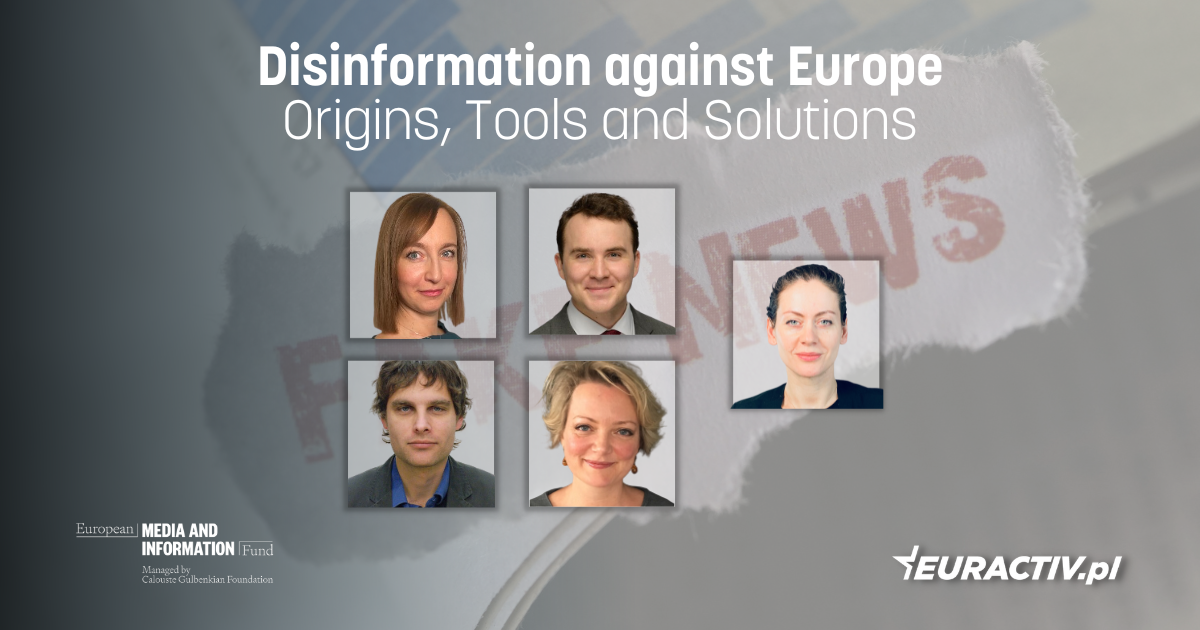
Combating disinformation, its origin and proposed solutions and tools was the topic of the webinar “Disinformation against Europe. Origins, Tool and Solutions” organised by EURACTIV.pl.
In an age of accelerating digitalisation and rising geopolitical threats, fake news is becoming even more common. It influences public perception of the world and is therefore exploited by actors hostile to the European Union. Some solutions to this problem are already being implemented at EU level, and special groups identify and combat disinformation targeting the EU.
https://www.focuseurope.300codes.website/bezpieczenstwo-i-obrona/interview/disinformation-widespread-in-poland-no-cure-has-been-invented-yet-interview/
Russian disinformation system
Head of the EU group for combatting Russian disinformation, East Stratcom Task Force, Martyna Bildziukiewicz, stressed that Russia and other international actors that are hostile to the EU, use disinformation in every possible way, “both online and offline.”
In her opinion, it is a common mistake to focus too much on online disinformation while neglecting the offline component of that phenomenon. She mentioned the Russian Orthodox Church as a frequently used source of disinformation, often promoting narrative similar to that of the Kremlin and the Russian state media.
This is an evidence for Russia having created a whole disinformation system that attacks people from each side, including via TV channels, social media accounts, but also its puppet figures, such as oligarchs or so-called useful idiots, she said.
As she said, the idea is to overwhelm the audience with too much content for it to handle. Hence the need for a multi-dimensional approach. The EU has to monitor the situation in the information sphere, raise social awareness of the threat and, finally, disrupt the disinformation activity, with blocking some Russian TV channels as one example. She also cited a need to enhance the ability to use various sources of information.
Each of these elements is equally important and only their combination allows successful tacking disinformation, according to the head of East Stratcom Task Force.
https://www.focuseurope.300codes.website/instytucje-ue/podcast/disinformation-series-dezinformacja-podcast-parlament-europejski-pandemia-fake-news-pe-unia-europejska-ue-szczepionki/
Disinformation stress-tests
Flint Group advisor Thomas Grandjouan praised the European Commission’s activity aimed at combating disinformation, which he said were much better developed than the activities by many other international organisations and governments.
There is always room for improvement, but this can be said about any situation, he added.
Disinformation threat and the scale that disinformation that can be used, for instance, to impact election results, became clear to everyone in the previous decade, he said, citing using civil war in Syria, Russian annexation of Crimea in 2014, as well as Brexit and US 2016 elections.
2016 turned out to be a breakthrough point, according to Grandjouan. It was then that Facebook announced it would mark fake news. Once global regulators have realised that disinformation is a real problem, they began to act. Moreover, protection data scandals, like the one concerning Cambridge Analytica, undermined public trust to private companies.
International tech giants, including Google, Meta, or Twitter, have established departments dealing with disinformation and began to cooperate with regulators, believing that only with the effort by experts, academics and fact checker it is possible to win over the disinformation epidemic.
Yet, the last years saw two serious stress tests for the system of combatting disinformation: the COVID-19 pandemic and Russian invasion of Ukraine, Grandjouan insisted. Those challenges have shown that self-regulating proves insufficient and there is a need for more active approach by the regulators.
“This is what European Commision does,” he said, citing another stress test coming with the European elections.
https://www.focuseurope.300codes.website/bezpieczenstwo-i-obrona/interview/nina-jankowicz-theres-absolutely-not-enough-attention-paid-to-regulations-around-disinformation-interview/
No school is disinformation-resistant
Lie Detectors founder Juliane von Reppert-Bismarck recommended raising awareness of the disinformation threat. “Why should we do that? The answer is stable: because we can,” she said, adding that the problem is not unmanageable.
She also explained how trainings look like for 8-10-year-old students that her organisation conducts. During the pandemic, the journalists were asked whether one can die of wearing a mask. At the beginning of the full-scale war in Ukraine the questions concerned the contradiction of information and whether journalists should be trusted if they all say what the governments expects them to say.
She said the COVID-19 pandemic has made everyone, including teachers, parents, but also children themselves, aware how crucial is media literacy.
Her organisation conduct classes in over 1,300 groups yearly. None of them is resistant to disinformation, regardless the material status, she stressed, adding that children must be explained that they should not share news quickly and with no reflection on social media.
Combating disinformation a neverending story?
Radio Free Europe/Radio Liberty journalist Rikard Jozwiak had a slightly more pessimist view. To his mind, it is impossible to eliminate disinformation.
The war in Ukraine will end, unlike the war against disinformation, which had no beginning and will last forever, he said, insisting that disinformation makes use of all the weaknesses of the open societies. Even in democracies, including the United States in Europe, some governments happen to spread disinformation, he said.
He pointed to the constant emergence of new disinformation accounts in social media, citing an outdated, “90s-like” method of message chains as an effective way to reach part of the population. No matter how hard we try, we cannot reach everyone with our knowledge, he said.
He also emphasised that setting up anything always requires a lot of time an effort, while ruining it takes seconds. Creating disinformation takes minutes, while verification of a piece of information may take several weeks.
Insisting the need to continue combating disinformation, he said one should never expect and ultimate victory in this fight.
Still, the conference participants pointed to the possibility to limit the reach and impact of disinformation and fake news. Effective tackling disinformation, however, requires collaborations of digital platforms, the media, regulators and policymakers, as well as community organisations and the public.
Wyłączna odpowiedzialność za wszelkie treści wspierane finansowo przez European Media and Information Fund spoczywa na autorze i niekoniecznie musi odzwierciedlać stanowisko EMIF i Partnerów Funduszu, Fundacji Calouste Gulbenkiana i Europejskiego Instytutu Uniwersyteckiego. / https://gulbenkian.pt/emifund/